
Pros & Cons of Different Soil Stabilizers
Compare 11 soil stabilizers: lime, cement, polymers, chlorides, heavy machinery, Perma-Zyme, pavement, aggregates, geosynthetics, fly ash, and plants.
7 min read
Soil amendments are materials that can improve earth’s strength, quality, or other properties. There are hundreds of soil amendments available, which can make choosing the right one for your project seem daunting. So, we’re here to help! We’ll start by defining soil amendments in more detail. Then, we’ll walk you through different uses and types, plus how to pick the best products for your project. Let’s get started!
Soil amendments are additives that change dirt’s chemical or physical properties to help it perform better at the job you need it to do. They can do things like harden soil, change its pH, prevent erosion, add nutrients for plants, and so on.
Amendments are as diverse as the problems they solve, which is why it’s crucial to choose one that works well for your project. Using the wrong product could degrade your soil—or even make it unusable. For instance, using lime to stabilize soil in a sensitive environment could upset its pH and harm the ecosystem. And using a soil hardener in your flowerbed will keep the roots from growing.
To that end, soil amendments improve your soil when you choose the right one for the job. Now, let’s explore what some of those jobs are.
There are soil amendments for all types of projects, from backyard gardens to massive industrial operations. To keep things simple, we’ve divided them into a few key categories:
Plants thrive when soil conditions are ideal for their species, but soil is often far from ideal. It can lack nutrients, drain too fast or too slow, have too much (or too little) of one specific soil type, or have other problems that make a plant say, “Nope, I won’t grow here!”
Amendments alter your soil to grow plants that are bigger, healthier, or even a different species than what might normally grow in a given area. They can improve soil aeration to deliver oxygen to the plants’ roots, make soil more acidic or alkaline, and retain just the right amount of water—all to promote healthy growth and abundant crops.
Fertilizers are great examples of agricultural soil amendments. They add nutrients like nitrogen, phosphorus, and potassium into soil to help plants grow. Soil conditioners improve dirt in other ways. For example, Harva-Zyme adds enzymes into the soil to help plants process nutrients and water. That way, plants can grow deeper root systems and yield bigger, better crops with less irrigation.
Contractors and engineers need another type of amendment called a soil stabilizer. As the name implies, soil stabilizers keep soil from moving under roads, buildings, bridges, and other structures. They also strengthen soil and improve its load-bearing capacity so projects last longer and perform better under stress.
Some soil stabilizers include lime, cement, chlorides, geosynthetics, and even certain plants. Here at Substrata, we make a solution called Perma-Zyme, which uses enzymes to bind soil into a hard surface that resists water and erosion. Our customers use Perma-Zyme to build unpaved roads, paved roads, oil and gas pads, ponds, and more.

Dust control is another major reason to use soil amendments. Whether it’s on roads, mine sites, or solar farms, dust is a problem. It impacts air quality and visibility—which can create seriously unsafe working conditions and impact neighboring communities.
Some soil stabilizers, like chlorides and Perma-Zyme, serve a dual purpose by offering dust control in addition to erosion control. Other products, such as Surfa-Zyme, are purpose-made dust suppressants. They form a strong crust over soil’s surface to keep its particles together, reducing airborne dust.
Usually, you’ll apply dust control amendments topically. Since they’re just on soil’s surface, they can wear off due to weather or traffic. They tend to need reapplications more often than products that mix into the soil. We recommend choosing eco-friendly, non-toxic options that won’t hurt the environment if they wash off.
This is one of our favorite soil amendment categories! Everyone should get to enjoy nature, so we love to see people remediate contaminated areas and restore old industrial sites for new uses.
Soil amendments play an important role in both of these things. Some of them can remove toxic chemicals from soil and help clean up oil spills—like Petra-Zyme, which uses enzymes to help the bacteria in soil break down petroleum particles and restore the environment to a safe, natural state.
Fun Fact: Some of our customers used Petra-Zyme to clean up geese after a diesel fuel spill. Thanks to this non-toxic solution, the geese safely returned to their pond.
Other soil amendments are helpful for restoring industrial areas like mine sites. And who wouldn’t love to turn an old surface mine into a beautiful sunflower field or a super fun golf course? In fact, mining companies worldwide now choose eco-friendly soil amendments to transform their old mine sites into new, sustainable ventures.
Soil amendments come in two main types: organic and inorganic. Simple enough, right?
Sometimes, you can safely use organic or inorganic products for the same projects, and other times, one option will be better than the other. Let’s see examples of each type. Then, we’ll explore some of their pros and cons to give you a better idea of when to use them.
Organic soil amendments are materials that come from living organisms and their byproducts, such as plants, manure, or even decaying, dead animals. Some organic soil amendments include:
We make organic soil amendments at Substrata—so of course, we think they have way more pros than cons! Our products all contain enzymes, which are proteins that come from living organisms. And they’re all natural and non-toxic. That’s because we believe everyone from homeowners to huge industries should get sustainable, eco-friendly soil amendments.
And that is the first benefit of organic options: they are the most eco-friendly. So, they can be a great choice for gardening, farming, remediating soil, or doing construction in environmentally sensitive areas. Many work safely around crops, native plants, wildlife, waterways, and people.
That said, you should choose carefully. Some organic products have limited strength and break down quickly. For example, you can’t stabilize a road subbase with straw; it’s too weak and decomposes too fast. But you could use Perma-Zyme, which strengthens soil over 10 times and withstands traffic for years with minimal maintenance. It’s all about knowing your project’s needs and what products can meet them.

Inorganic amendments come from minerals, chemicals, and other non-living matter. Examples include:
Inorganic soil amendments are typically stronger and last longer than organic options. If you mix manure into your soil, you’ll never see it again because it’ll break down; if you mix in gravel, it’ll stay for decades! That makes inorganic amendments good for construction, engineering, and other long-term projects where soil must stay in place for years.
Many inorganic amendments are also natural. Clay, crushed rock, dirty gravel, and sand all come from the earth, and they go into your soil with little to no processing. That said, processed materials are more complicated to use. Take lime and cement for example. They come from rocks that undergo chemical treatments to make them useful for construction, as well as agriculture and remediation in lime’s case. But, those chemical alterations can imbalance soil and harm the surrounding ecosystem if you use too much of these materials or use them in the wrong place.
Inorganic soil amendments can also be dusty. They may reduce air quality, lower visibility, and irritate your skin, eyes, or lungs. Long-term exposure can cause serious illnesses like silicosis or lung cancer. So, when you need to use these products, please wear PPE and follow safe-handling guidelines to reduce your health risks.
As you’ve seen, all soil amendments have pros and cons. The key is finding the best option(s) to fit your project’s goals. In this section, we’ll teach you a simple four-step process to help you choose.
There are four types of soil, each with unique properties. Every soil type needs different amendments to enhance or alter those natural properties. So, identifying your soil type will be your first clue as to what amendments it might need and how it will react to certain products.
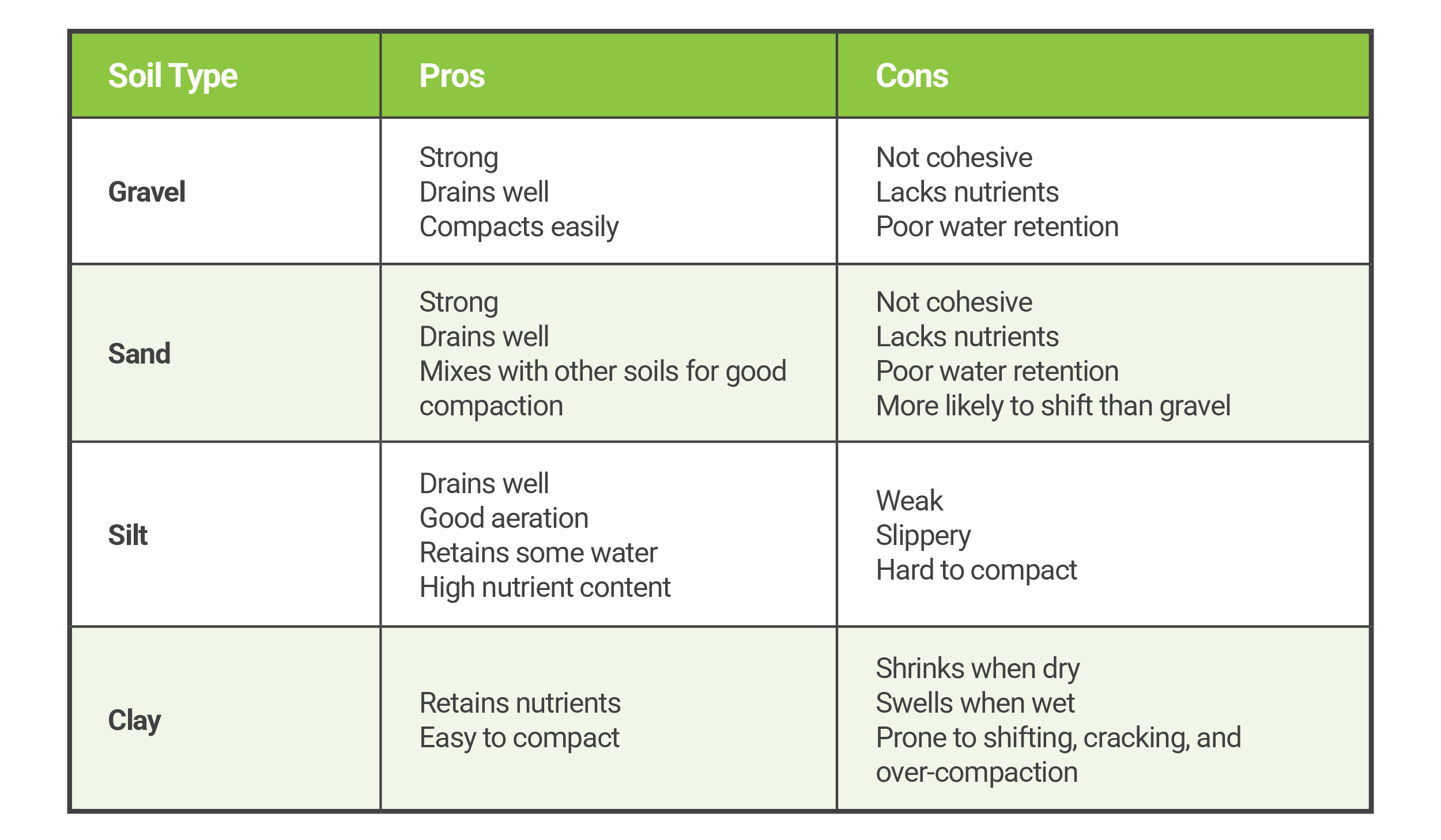 Most soils are loams, which contain multiple types and usually adopt the traits of each type in proportion to how much they contain. So, let’s say your soil is a silty loam. It will act most like silt because that’s the dominant soil in the mixture. Amendments for silt will be your best starting points, but know they may react differently due to the other soil types in the mix. You may need additional amendments to address those soils.
You can find out what type of soil you have in several ways—from rolling it in your hand to see if it sticks together to having a standardized sieve test in a lab.
Fun Fact: Clay soil sometimes needs amendments to work properly for certain projects… and sometimes, clay is the amendment! Some of our customers import clay to make their soil react better with our Perma-Zyme soil stabilizer.
Knowing your project’s scope will narrow down your options right away. Consider farming silty soil, for example. You might add fertilizer to adjust the nutrient content or Harva-Zyme to grow deeper roots. But if you’re trying to stop erosion on a dirt road, fertilizers and soil conditioners won’t help. You need amendments that strengthen soil, such as lime, gravel, or Perma-Zyme.
From there, you can consider other requirements like your project size and budget. A homeowner who wants to stabilize their driveway will have a smaller project and budget than a county that’s managing hundreds of miles of dirt roads—meaning lime will likely be cost-prohibitive.
Every project has a deeper purpose. Because the truth is, you don’t need soil amendments just to fix your dirt. You need soil amendments to fix your dirt so that you can reach a good end result, like growing food for a global market or creating reliable roads for your community.
Our Perma-Zyme customers are great examples of this. They come to us because they have soil problems, and they even have temporary ways to fix them. But they’re seeking a long-term solution that meets their real goals. 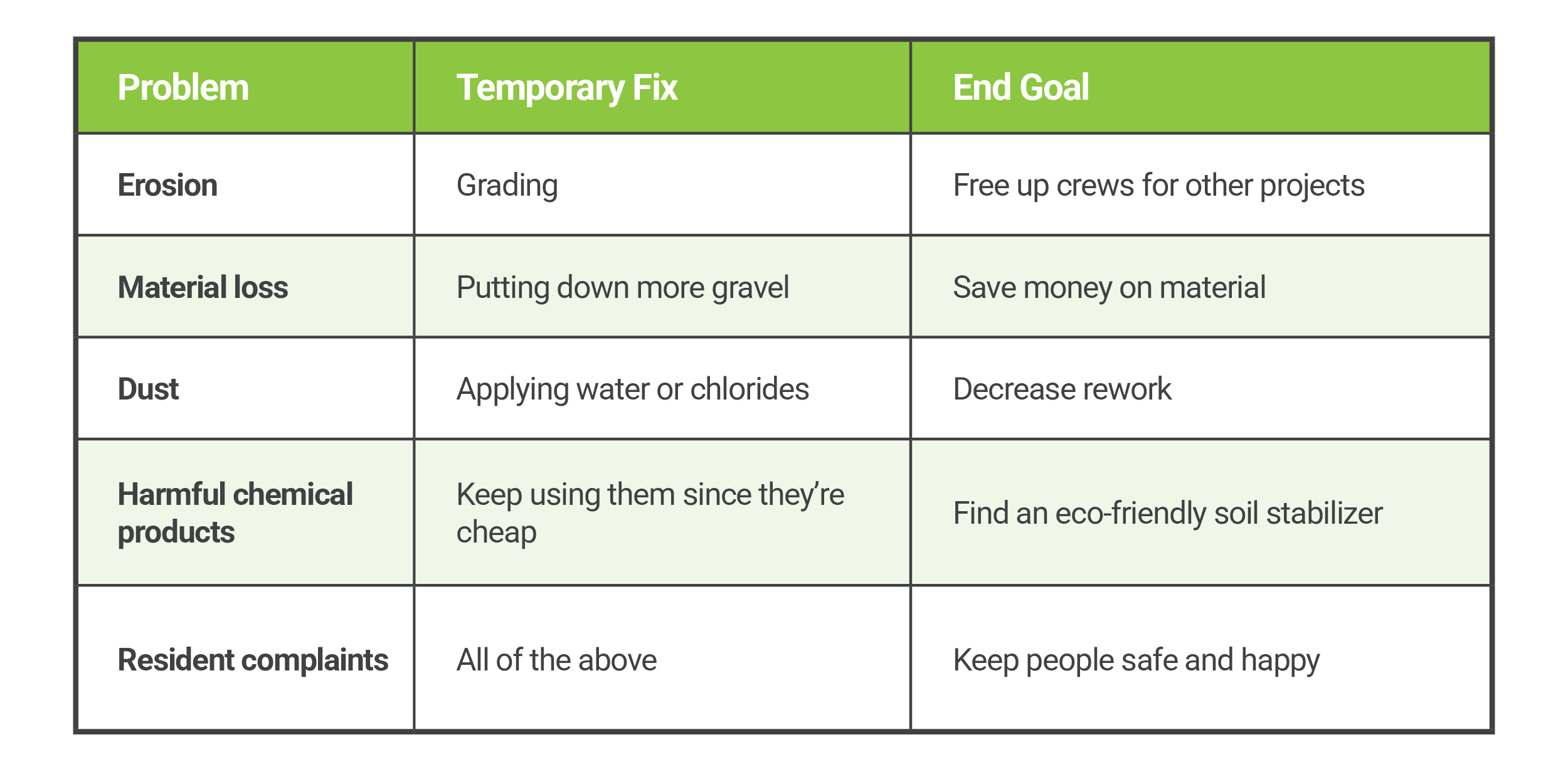 As you can see, there’s a bigger “why” behind every soil amendment. For our customers, Perma-Zyme meets those long-term goals. And whatever your project may be, clarifying its purpose will guide you toward the right soil amendments for you.
During this step, you’re gathering as much information as you can about soil amendments that suit your soil type, project, and end goals. Ask questions like:
As you answer these questions, you’ll rule out soil amendments that are too expensive, high maintenance, or harmful—and you’ll keep the better options on the table.

This may seem obvious, but actually choosing a soil amendment is the most important part of the process! Now is when you commit to using a specific product—or several products.
When you find soil amendments that work well together, you can get the best of both worlds. And that frees you up to choose the most cost-effective, long-lasting options for your project. For example, you may pair a gravel topcoat with Perma-Zyme to strengthen your dirt road and prevent erosion and material loss—which will save you thousands of dollars per year on maintenance.
Whether you’re stabilizing a road, planting crops, suppressing dust, or anything else, the key is finding the products that fit your needs and long-term goals. We hope learning this four-step process will help you choose the best soil amendments for your next project!
Compare 11 soil stabilizers: lime, cement, polymers, chlorides, heavy machinery, Perma-Zyme, pavement, aggregates, geosynthetics, fly ash, and plants.
Optimum moisture content is the ideal amount of water soil needs to compact into a strong surface. Learn how to check for it in the lab and the field!

Perma-Zyme is a popular road stabilizer, but it can do more! Explore 13 uses for mining, solar energy, agriculture, recreation, private property, and...