
1 min read
Clay 101: Characteristics, Types, Pros, Cons, & Construction Tips
Working with clay soil is tough for any project—from county roads to multi-acre drilling pads to small home gardens. To succeed, you must understand...
7 min read
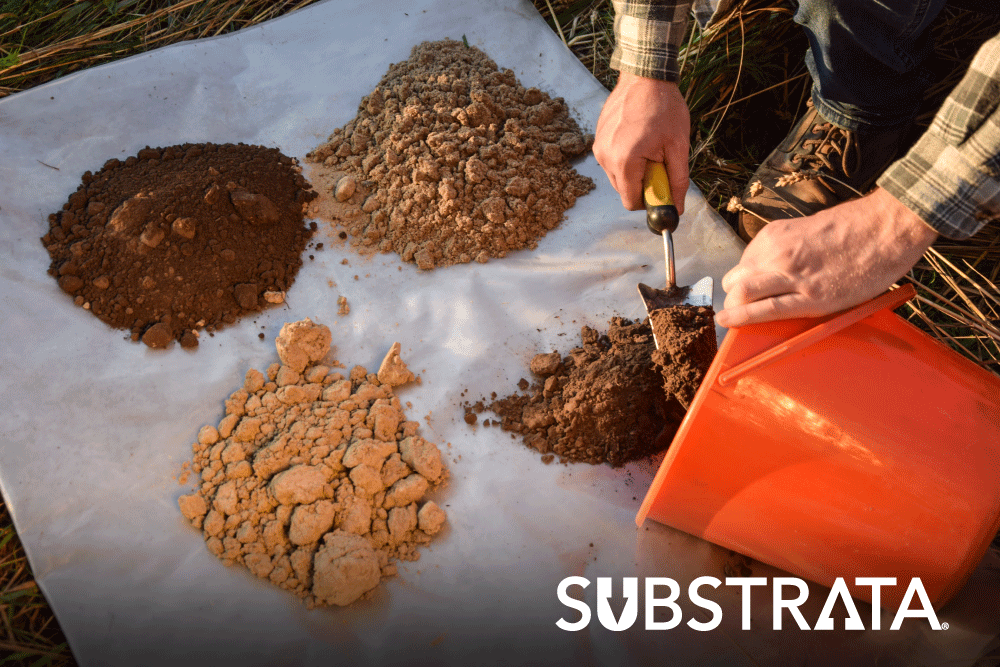
Soil classifications are the key to construction, engineering, and agriculture. Knowing your soil type tells you how to use and improve it. And you’re in luck! You can classify your soil in several ways.
We’ll teach you four methods:
First, let’s cover why there are so many ways to classify soil. Then, we’ll explore each method and its significance.
To most people, soil classifications may seem silly. Dirt is dirt, right? But actually, these classifications are essential to help our society thrive. That’s because people have different purposes for the soil on their jobsites.
For paved roads, contractors need a strong gravel subbase that won’t shift under traffic. But what about dirt roads on clay soil? Clay is weaker and more prone to erosion, so contractors need to stabilize the clay to make it strong enough to support traffic.
The same goes for other industries. A farmer growing watermelons needs sandy soil that drains well, but a farmer who’s growing beans needs silty, nutrient-rich soil. And nobody wants a field full of gravel where plants won’t grow!
Since people use soil in so many ways, we have multiple soil classification methods to help them maximize their soil’s benefits and offset its pitfalls. So, let’s dig into the four main soil classification systems!
Geotechnical engineer Arthur Casagrande invented the USCS during World War II to help the U.S. Army Corps of Engineers classify soils for building airport runways.1 Today, this system helps engineers and contractors know how soil will compact and bear loads—or, if it can’t do those things, how to stabilize it.
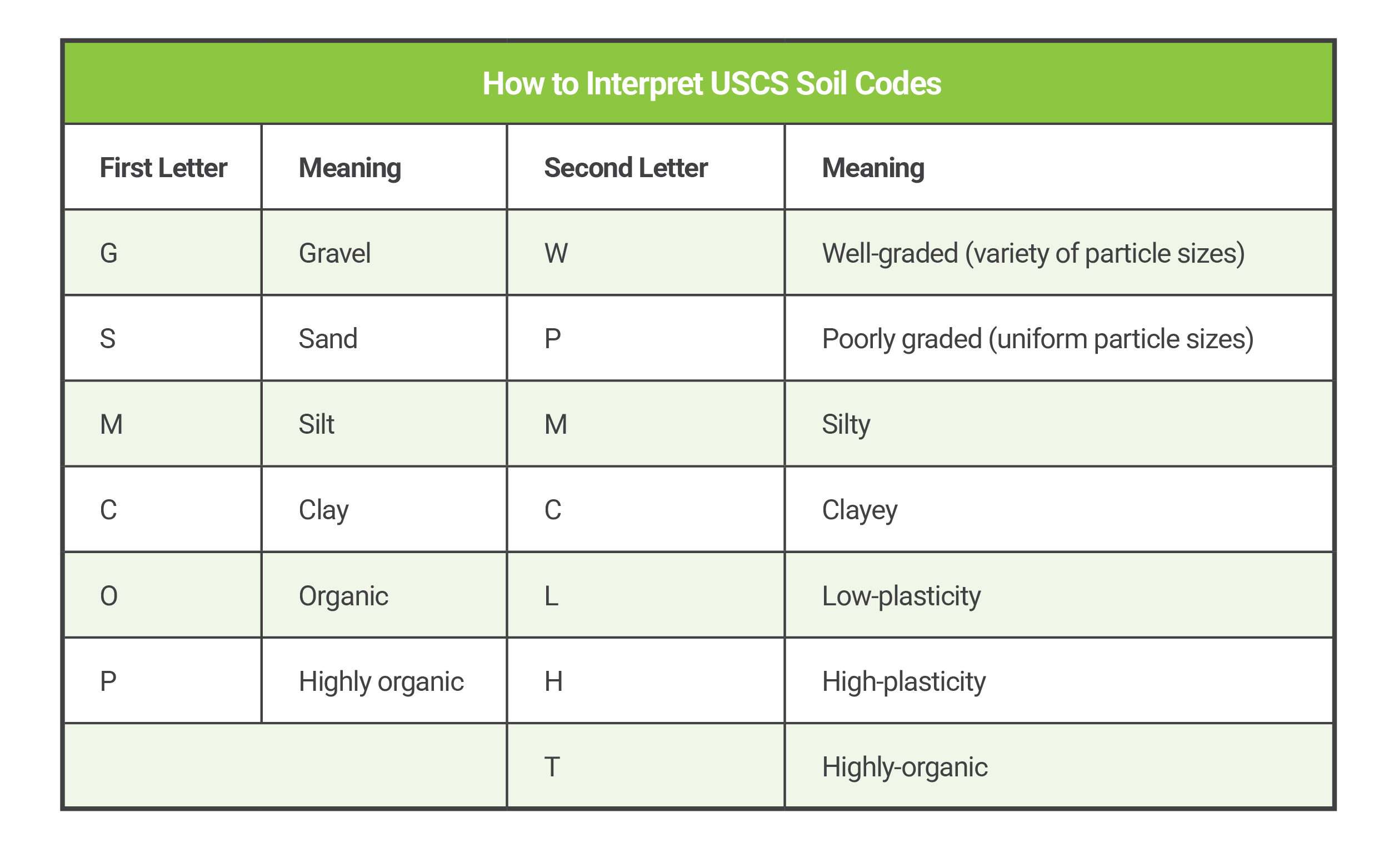
The USCS groups soil based on grain size and plasticity. Each soil type has a two-letter code revealing its composition and key traits. Let’s dig deeper!
First, the USCS sieve tests soil to separate it by grain size. Smaller grains fall through the sieve’s mesh bottom, while larger grains stay on top. The USCS uses the #200 sieve to classify soil into two groups:
Those distinctions are a good start, but they’re too basic for most projects. Coarse soil grains can range from 0.075mm to 10 inches wide—which would produce very different results during construction! Contractors need more info to know how to use soil effectively. Fortunately, the USCS breaks coarse and fine soils down further.

Coarse soils fit into two subgroups based on grain size: gravel or sand.
You might be thinking, Wait, gravel is rock! True, but enough rocks change how your soil behaves. So, the USCS classifies gravel as soil where over half of the coarse grains are too big to pass through a #4 sieve—or at least 4.75 millimeters wide.
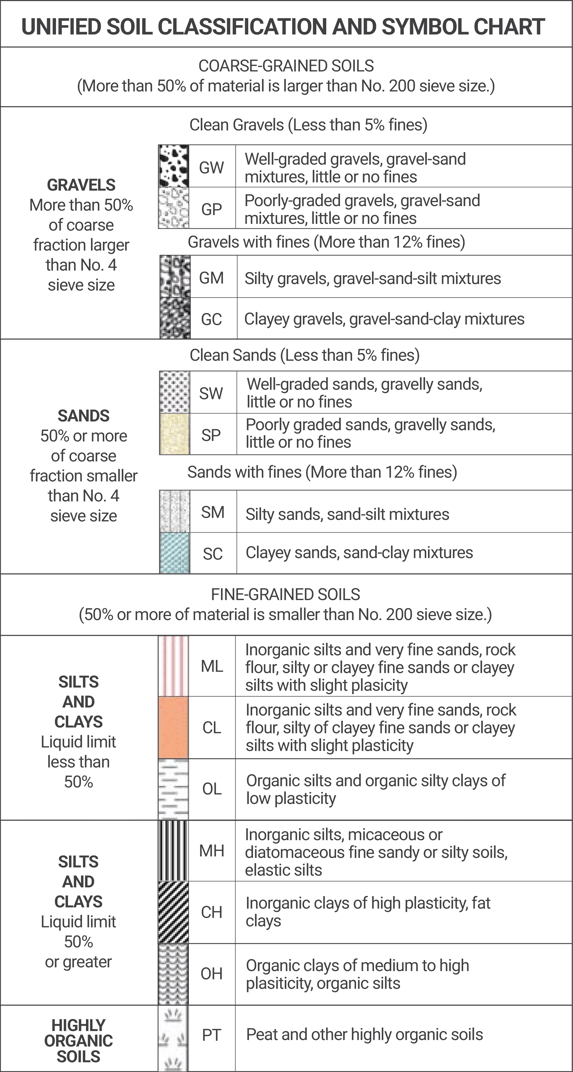
The USCS classifies four gravel types based on particle size distribution and other soil content. 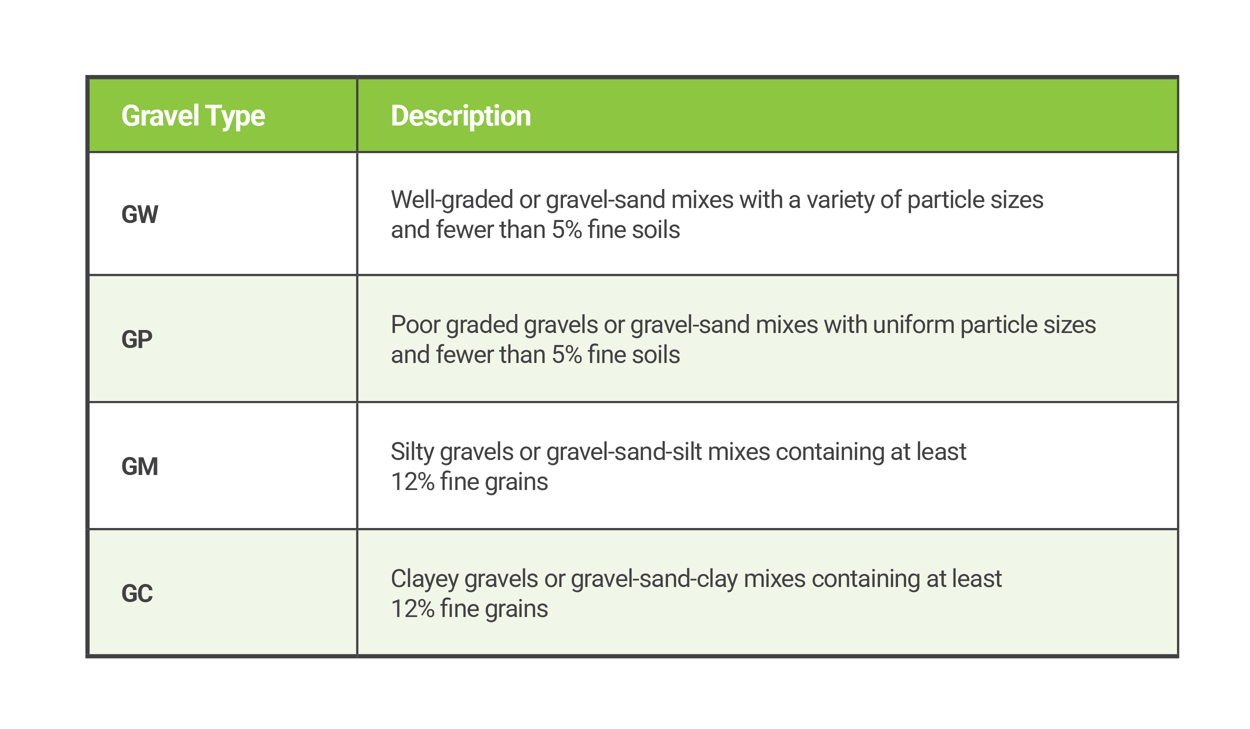 The “best” type of gravel depends on your project. For instance, GWs compact well and have good load-bearing capacity thanks to their different particle sizes, but some projects may need the uniform rocks of GP gravels.
Like gravel, sand is coarse soil where over half the grains cannot pass through a #200 sieve. However, at least 50% of sand’s coarse fragments can pass the #4 sieve. There are four kinds of sand.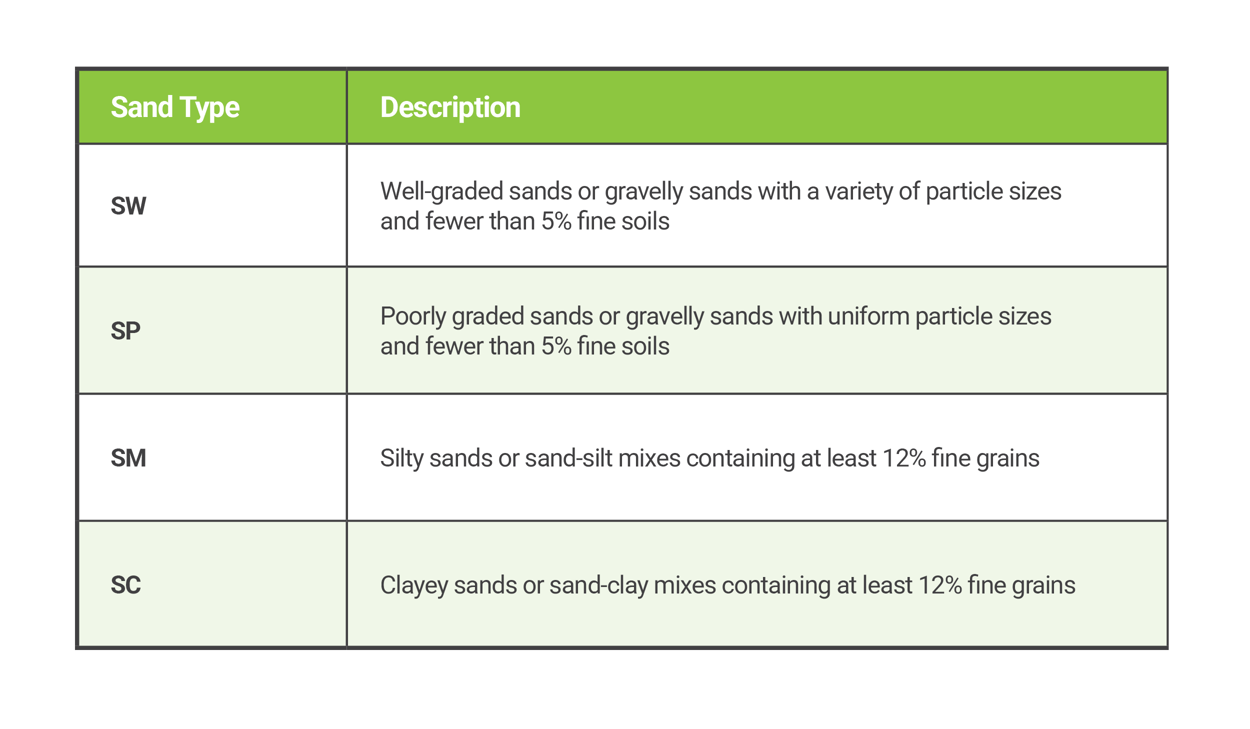
Sandy soils can be hard to compact by themselves. But, mixing them into fine soils aids compaction because the smaller silt and clay gains can stick to the larger sand. Thanks to clay’s cohesive nature, SCs may be easier to compact than other sands.
USCS classifies fine soils fit into three groups:
Before we cover these, let’s talk about plasticity. Plasticity refers to soil’s ability to retain water. All fine soils can retain some water and stay workable for construction. But when they get too wet, they turn into mud (aka liquid). High-plasticity soils can retain lots of water; low-plasticity soils, only a little.
We’ll compare low- and high-plasticity soils together. Then, we’ll move on to highly organic soils.
Low-plasticity silts and clays become liquid when they contain less than 50% water. High-plasticity ones become liquid when they contain 50% water or more. The USCS marks low-plasticity soils with an L and high-plasticity with an H.
Silts and clays in both groups can be inorganic minerals or organic matter from once-living organisms, like decaying leaves. Oorganic silts and clays differ from highly organic soils. We’ll explain that in the next section, but first, let’s cover the six kinds of silts and clays.
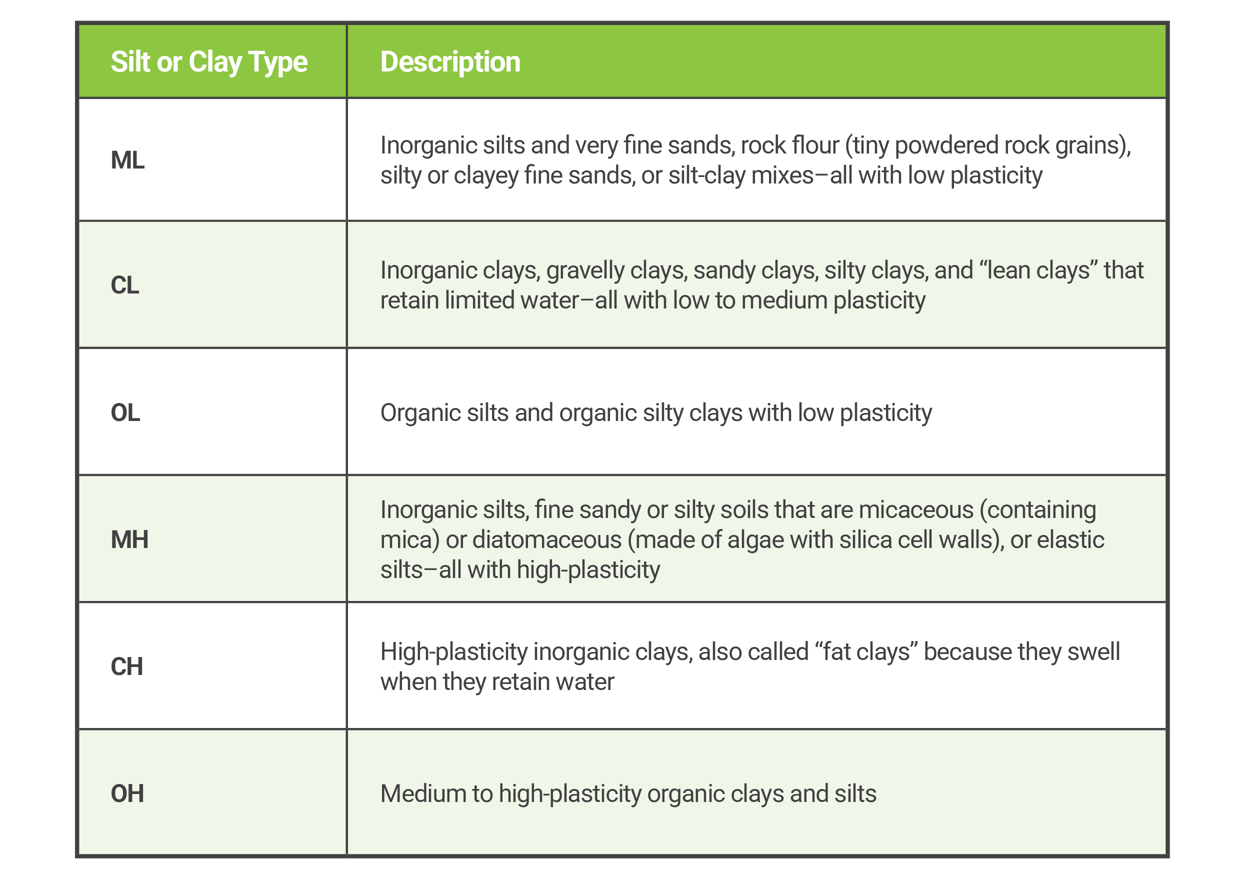
Silts and clays are essential for construction because soil can only compact when it’s plastic, retaining enough water to hold shapes instead of crumbling like dust or squishing like mud.
Clay is easier to compact than silt since it retains more water; plus, silt’s round grains struggle to bind together. But, clay may shrink and swell with moisture changes after construction. All fine soils may be weak and erosive, so engineers must stabilize them with products like Perma-Zyme, a natural solution that hardens clay to resist erosion.
Whereas organic silts and clays contain some organic matter mixed with minerals, highly organic soils contain almost all organic matter. Highly organic soils form in wetlands when many dead plants and organisms decompose in and around water. You may hear people call them bog soil or fen soil, after types of wetlands where they can develop.
The USCS only gives highly organic soils one class: PT, short for “peat or other highly organic soils.”
To easily recall USCS soil classes, use the summary chart below. We also made a chart to decode the two-letter soil abbreviations, so you can see how different soil classes got their names.
Like the USCS, the AASHTO system uses grain size and plasticity to classify soils for civil engineering. However, AASHTO is specifically for transportation infrastructure like roads and runways. It also rates each soil’s usability as a subgrade, unlike the USCS.
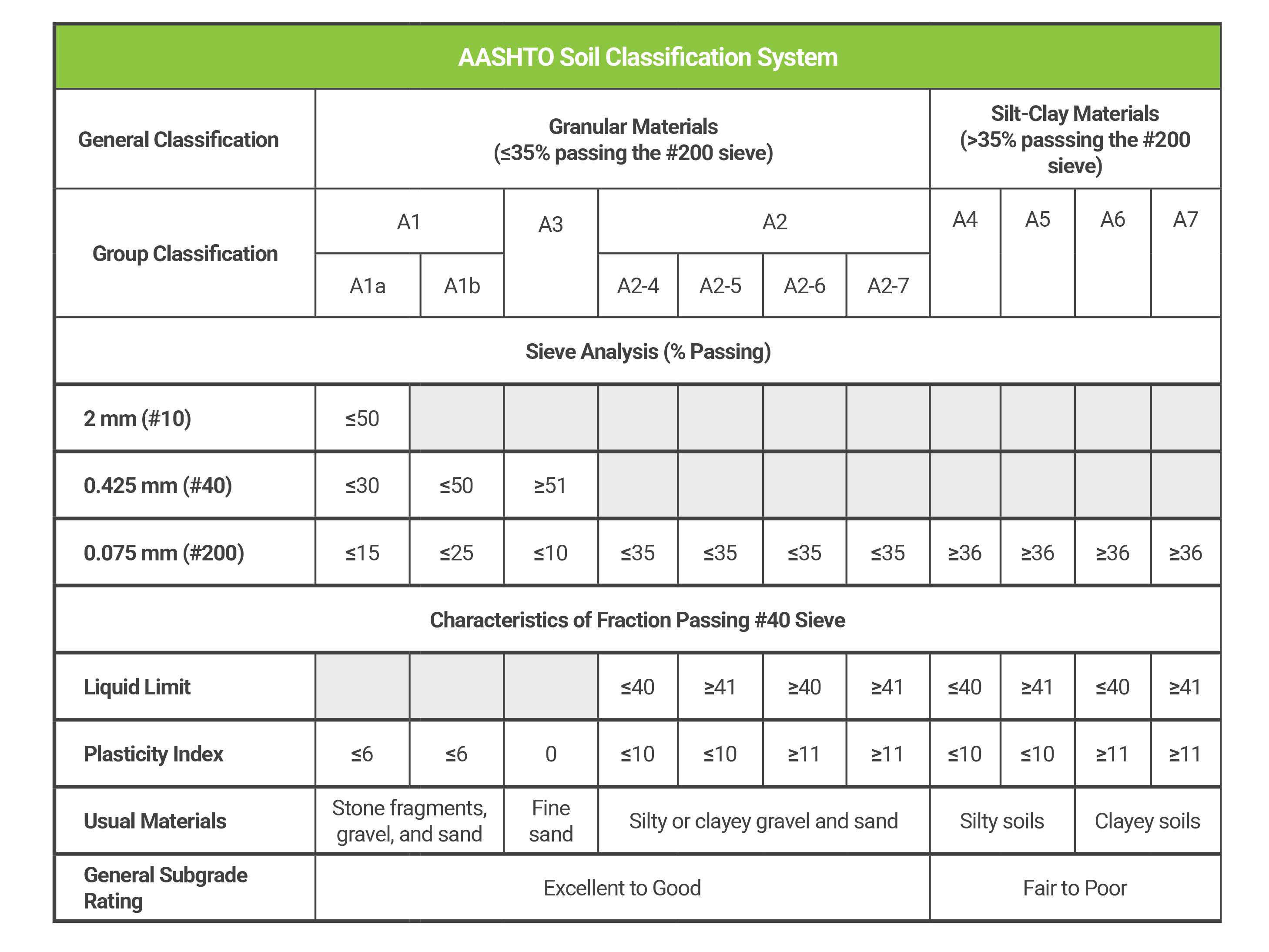
AASHTO first classifies soil by grain size. Soils where 65% or more material stays on top of the #200 sieve are granular. Soils where over 35% of the soil passes the #200 sieve are silt-clay.
AASHTO then subgroups soil by particle size distribution (the percent of particles that are each size) and plasticity index (the percent of water soil can gain or lose before becoming too wet or dry to compact). They number these subgroups A1 through A7.
Granular materials would classify as gravel or sand in the USCS. AASHTO rates these soils excellent to good for subbase because they’re strong, with great load-bearing capacity to keep roads from shifting.
A1 soils have the largest particles, with only 15-25% of material passing the #200 sieve. They also have low to no plasticity. Within this class are two subtypes, A1a and A1b. A1b soils have slightly smaller grains than A1a soils.
A2 sands and gravels contain more silt and clay, with up to 35% material passing the #200 sieve. They can have a higher plasticity index, depending on the clay or silt they contain. Some A2 soils may have plasticity indices over 10%.
A3 soils are sandy with smaller, more uniform grains than A1 or A2 soils. A3 soils are non-plastic, meaning they can’t retain water. Finally, they contain the least silt or clay of any class, with 90% or more material staying on top of the #200 sieve.
Silt-clay materials are equivalent to USCS fine soils. AASHTO rates these soils as fair to poor for subgrade because they may be weak or shift with moisture changes, causing potholes or cracking pavement. But like we said earlier, some silt-clay material is essential to compact soil during construction.
To qualify as silt-clay, at least 36% of the soil must pass through the #200 sieve. From there, AASHTO further classifies silt-clay soils by plasticity index and liquid limit, the point where soil retains so much water that it becomes mud.
A4 and A5 soils are silty with a plasticity index of 10% or less. A4 soils have a lower liquid limit. They turn to mud when they contain 40% water or less, while A5 soils become liquid at 41% water or more.
A6 clays have a liquid limit of 40% water or less; A7 clays, 41% or more. Both types have higher plasticity indices than A4 and A5 silts, at 11% or higher. So, A7 clays can retain more water than any other soil; the USCS would classify them as CH or OH soils.
Over 800 American construction workers die on the job annually, including during trench collapses. One cubic yard of soil can weigh one and a half tons—as much as a car—and crush or suffocate workers if it falls on them.1 So, OSHA created a soil classification system for safety.
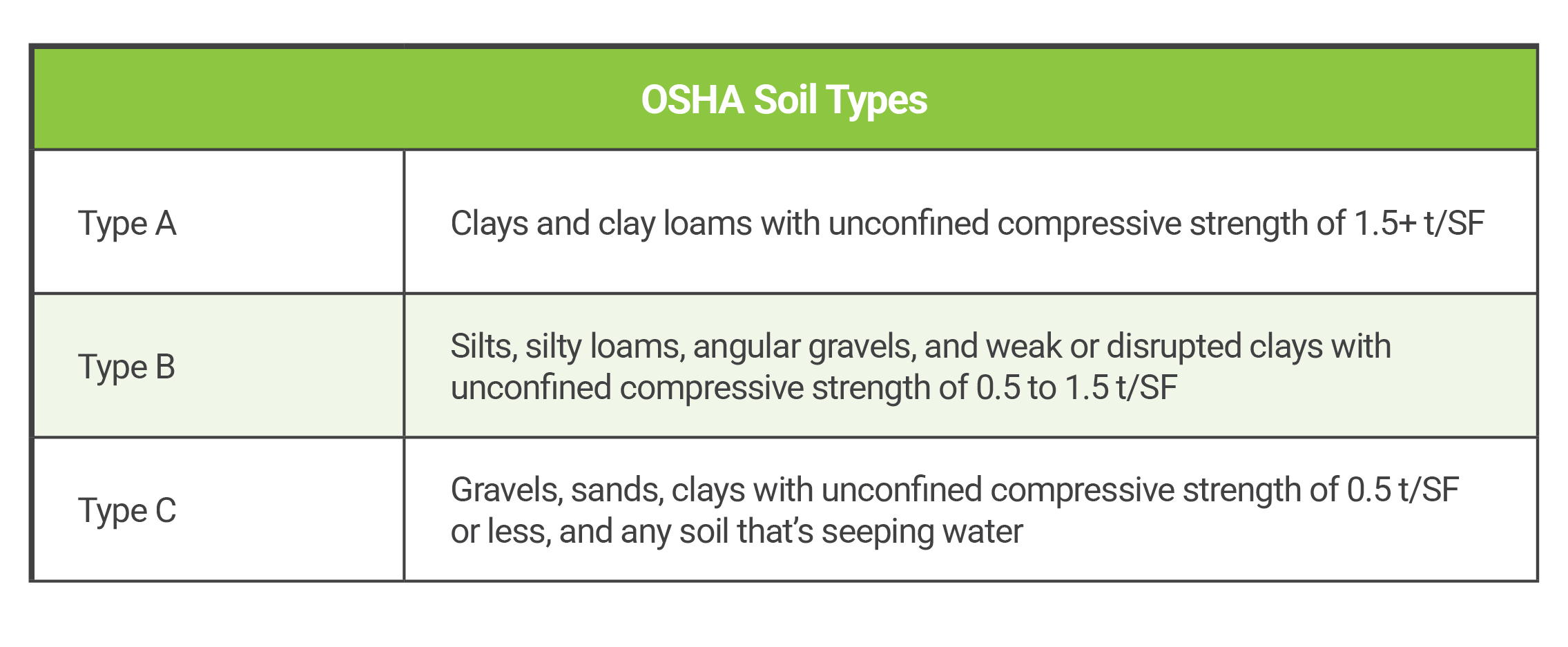
OSHA classifies soils into three types, each with different requirements for shoring and trenching safety. Contractors must follow OSHA’s guidelines to stabilize each soil type when working below the surface. Some guidelines include:
Type A soil is the safest and most stable because it’s cohesive, meaning it sticks together. Cohesive soil is least likely to collapse. Clays and clay loams—which are clays that contain some silt, sand, or gravel—are the most cohesive soils.
Type A soils have high unconfined compressive strength of at least 1.5 tons per square foot. However, they have some limits. Clay can’t be Type A if it has:
These things can destabilize even the most cohesive soil and increase its chance of collapse.
Type B soil includes silt, silty loams, angular gravels, and clays that don’t qualify as Type A due to fissures or vibrations. These soils are slightly cohesive, but some pieces don’t stick together well because they’ve been cracked or disturbed. Type B soil also has a lower unconfined compressive strength, between 0.5 and 1.5 tons per square foot.
The least stable, most dangerous soils are Type C. These include:
Water seepage is especially dangerous because it loosens soil, and conditions can change unexpectedly, especially with temperature fluctuations.
The USDA classifies soil by texture. This helps farmers and gardeners grow plants. Since we specialize in soil stabilization for construction here at Substrata, we’ll touch on the USDA system briefly.
The USDA classifies soil based on three main textures: sand, silt, and clay. They identify subtypes based on the percentage of each texture the soil contains. For example, silty clay contains 40-60% clay and 40-60% silt. The USDA depicts these mixtures on a triangular scale.
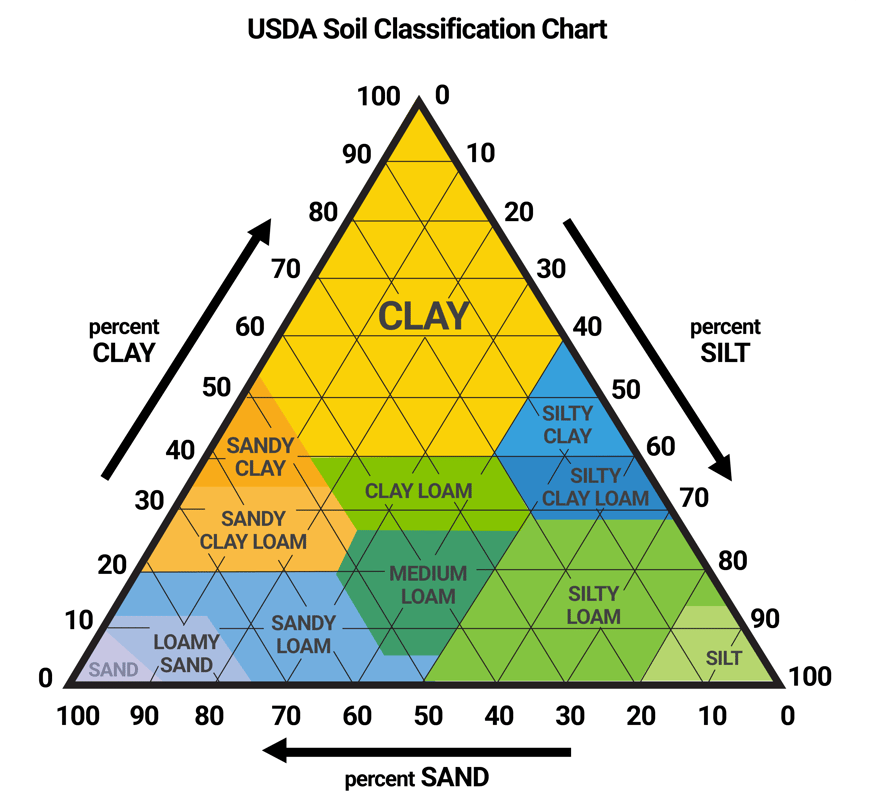
Unlike other classification systems, the USDA doesn’t include gravel because plants can’t grow in it.
Now, you know how and why people classify soil for construction, engineering, safety, and agriculture. Let’s recap the four systems:
If you’re working with soil for construction or engineering, we’re here to help! We’ve been stabilizing soil for over 50 years, and we’ve put together a free guide called Soil Stabilization Methods & How to Choose Them to help you solve your soil challenges.
1 min read
Working with clay soil is tough for any project—from county roads to multi-acre drilling pads to small home gardens. To succeed, you must understand...
1 min read
Soil’s Atterberg limits are essential to know for successfully constructing roads, buildings, and other projects. But, they’re about as clear as mud...
1 min read
Strong roads start with strong soil. When soil stays in place, the road’s surface lasts longer and stays safer. The trouble is that the soil in many...